
Recently I’ve been thinking about what it takes to be a great CxO. I’d like to get there someday whether it’s for a company I’ve started or a longstanding company that excites me. With this as my goal I have closely watched Vivint’s c-staff and taken notes on what makes them tick. One of the biggest metaskills they all share is their ability to make decisions.
I believe that the ability to make good decisions is a skillset we should all strive for. Decisions regarding relationships, career choices, personal finance, and other personal decisions can benefit from a robust decision-making process.
While there are a plethora of “x steps to make the right decision” posts, I’d like to share a few points of the decision-making process that have helped me. This is by no means a comprehensive list ( the “make the decision” point that seems to plague every other list is purposefully absent) but rather a handful of strategies you can try out.
Define the decision
I often find myself saying “What I need to figure out is… [insert rambling run-on sentence here]”. Making a decision is already difficult, but not being able to explicitly state the decision you are making makes it even more difficult.
Simplified, there are only a few types of decisions:
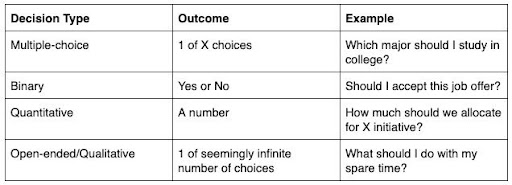
By first determining what decision type your decisions falls under, it should make it much easier to concisely state your decision. A lot of clarity comes with being able to boil the decision to a succinct statement.
You should also fully explore the options. If your decision is a multiple-choice type, write down all the potential choices and acknowledge that there are choices that you haven’t discovered yet, and determine how you can quickly discover them. If your decision is a quantitative type, determine the parameters. Establish the potential floor and ceiling. If the decision is a open-ended or qualitative type, do your best to see if you can morph it into a multiple-choice or quantitative.
Establish your vision and goals for what the decision will accomplish
Determine what the goal posts are for this decision. Some guiding questions can include:
- What brought about this decision in the first place?
- What does a correct decision look like?
- What does an incorrect decision look like?
- What is the outcome of a successful decision?
- What is the outcome of a poorly-made decision?
With a lot of business decisions, this may already be decided for you. You will likely optimize for what will bring in the most revenue, cut the most costs, gain the most customers, or attack the biggest market.
With more personal decisions this can be much more difficult. Whether or not to pursue a relationship, which job offer to take, or where to live are deeply personal decisions that don’t necessarily have a right or wrong answer. These may require some deep soul searching on what your core values are, what is important to you, and what you want your life to look like. I am definitely not an expert in this area. However, I will say that I have always felt comfortable with my decisions when I turn inward and do what I feel is right, not what others expect of me.
Gather the data: explore first and second order consequences
First order consequences are generally pretty easy to see. However, second-order consequences take significantly more time and effort to discover, but can lead to very valuable insight. These consequences are not necessarily top of mind and will take some think-time.
Let’s pretend that you are trying to determine whether you should take a job offer in a different city. First-order consequences might include:
- You will get paid more
- You will experience life in a new city which will include new relationships
- You will be taking a significant step in your career
- Worse work/life balance
Second-order consequences might include:
- You will need to supply a greater amount of energy to continue relationships you’ve built in your current city, and you will inevitably grow apart from some
- You will be further cementing your role in X industry and Y role
- Your new apartment is 15 minutes from the nearest grocery store rather than 3 minutes and parking is horrendous
Ok, maybe that last one is a 3rd-order consequence. But even so, it is important to do a deep dive into each choice. You could gain insights from studying these 2nd-order consequences that may potential sway your decision.
Determine your margin for error
This balances out the previous point. Some people suffer from decision paralysis and continue to explore consequences down to the xth-order. You will need to establish how confident you need to be in your decision which will directly determine how deep you need to go in your consequence exploration.
To put this into perspective, I recommend using the Pareto distribution. Commonly known the distribution that yields the “80/20 Rule”, this power-law probability distribution will show you how much relative effort you will have to expel in order to increase your confidence level.
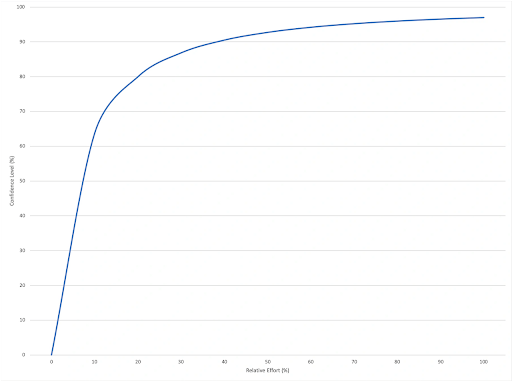
While I believe that 2nd and 3rd order consequences can be important to take into consideration you’ll need to decide when enough is enough. This will vary based on the impact and length of the decision you will be making. Determining who you will marry will require a significantly different level of depth than determining where you will go on vacation for spring break.
Leverage resources like mental models and outside insight to help frame data
There may be additional mental models that help you frame the data you’ve collected in a certain way. And while I believe data is king, I have found outside insight that is qualitative in nature to be extremely valuable. I believe there are multiple resources to help you determine how you should look at the data:
- Your own experience
- Others the decision will impact (subjective)
- Others the decision will not impact (objective)
- Books, podcasts, blogs, and articles
- Others who have made similar decisions
- Mentors
- Friends and family
- A higher source (e.g. God)
Conclusion
Rather than ending with a cheesy motivational quote about the importance of decisions (I’ll leave that to Stephen Covey), I’ll leave it to E-40. Whether you’re deciding if you should raise capital for a new venture, determining which school to go to, or what career you should pursue, “everybody got choices.”
 Tanner Johnston