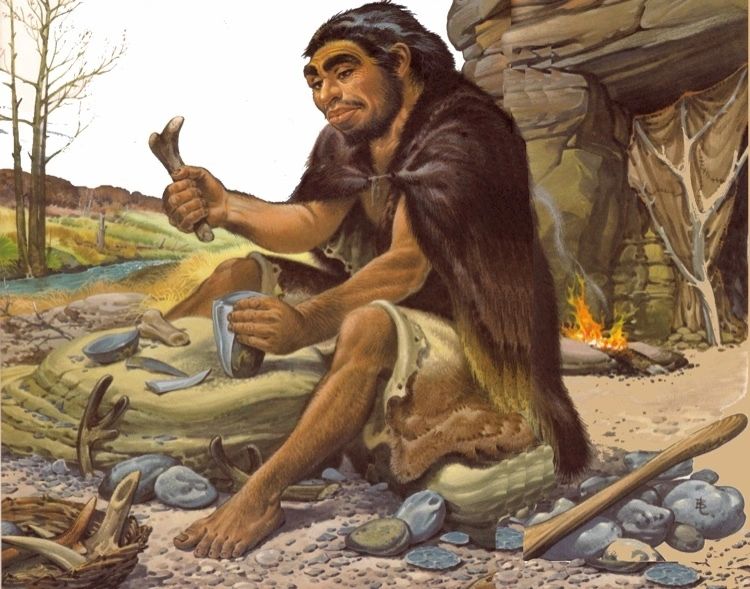
Evolution has allowed organisms both big and small to become more efficient and advance in their capability to survive. For millions of years the earth’s inhabitants grew and advanced by this slow yet steady process. As the weak died and others began adapting to the environment, plants and animals continued on a linear yet upward trajectory.
Then homo sapiens appeared.
We went through multiple stages of trajectory changes including the cognitive, agricultural, and scientific revolutions. Our advancement was no longer dependent on the slow-moving processes of evolution, it was in our own hands. We could progress exponentially, rather than linearly, as we began to adapt to the environment with innovative widgets and processes.
However, our bodies are still stuck on this slow trajectory. Evolution is a slow process, taking hundreds of thousands of years to make small changes. However, we have subjected ourselves to thousands of lifestyle changes in just the past few centuries. And while inventions, discoveries, and research have extended the human life-span and made our lives more comfortable, our bodies are still extremely biologically similar to those of our ancestors thousands of years ago. Our bodies can’t keep up with innovation!
This is evidenced in many of the health issues we see today. Many health problems we face have come to rise in the last few hundred years, a small fraction of the time we as homo sapiens have existed. Since these health problems are new, we know that they are the result of ecosystem and situational changes and not biology, as evolution occurs on the scale of hundreds of thousands of years, not hundreds. As we created new solutions with technology, we also created new problems. We become more efficient at a cost that our bodies have to bear.
My argument is that as we look towards future wellness solutions, the answers will be found by simultaneously looking to the past as we innovate for the future. Rather than creating purely synthetic solutions, we can make sure that technology enhances our wellness using our natural bodies, not in spite of them. We should be looking back at the work that evolution has already done for us, and not try to reinvent the wheel.
Here are a few examples of wellness products who are seeking to fix problems that innovations have caused.

Altra Shoes
The first homo sapiens were found 400,000 years ago, but the first shoes weren’t made until a mere 3,500 years ago in ancient Mesopotamia. Humans have been traveling by foot, both walking and running, for hundreds of thousands of years before the invention of the shoe. As running has become a popular form of exercise over the past few hundred years, padded running shoes became the norm. The average running shoe has a raised heel to propel the runner forward and a soft, squishy material for shock absorption.The raised heel of a running shoe causes many runners to lead with their heel and then roll onto their forefoot. This is called running with a heel strike. This can cause undue stress on lower-body joints. And the overly-padded shoes, while comfortable, give rest to ligaments that have been developed over thousands of years for this exact purpose. Did our ancestors also experience constant back pain, knee pain, and weak ankles?
Altra has created a shoe that allows the runner to run naturally while still providing comfort and protection from sharp rocks. They leverage a zero-drop heel, meaning that the heel sits as high as the forefoot, to mimic how the actual foot is meant to stand. This makes it much easier to run as humans were meant to, with a forefoot or midfoot strike. They also have an extremely-wide, and funky looking, toe box that allows your metatarsals and phalanges to fully widen out while running. Their shoes range from minimal padding, for those who want the full experience, to high levels of padding, for those of us who don’t have the time to condition our feet to the elements.

Squatty Potty
Our ancestors went #2 exactly how you think they would: by squatting. The first flushable toilet was invented in 1596 by Sir John Hushington. Within a matter of a few hundred years, we went from squatting to sitting. The mechanics of the toilet make so that the average floor to seat height is just over 16”. You would think that the difference between sitting and squatting isn’t that big of a deal, but it is. Your body relies on a bend in the colon and anus to keep your waste inside. Sitting on a toilet, for most people, doesn’t allow the bend to fully elongate and allow for a full bowel movement. Constipation, bloating, and hemorrhoids are significantly less prevalent in countries where it is customary to squat.
The Squatty Potty is a simple stool that you place your feet on when you go to the bathroom. It allows a much more natural squatting position. It is clinically proven to eliminate strain by 91%, increase emptiness by 85%, and decrease time spent by 71%.
I think there are many opportunities to innovate but still adhere to the work that nature has done for us.
Baby bottles and pacifiers
There is a theory that connects the introduction of baby bottles to the discovery of sleep apnea. High palates, narrow dental arches, and overjets, which are all correlated with sleep apnea, were extremely rare until the introduction of baby bottles and pacifiers. While a mother’s breast is soft and will adapt to a child’s mouth, a bottle is much harder and forces the child’s mouth to adapt to it. Also, a child only has to “suck” on a baby bottle, while breastfeeding forces the child to chew, suck, and move their tongue. For those whom breastfeeding is not an option, there’s an opportunity to create baby bottles and pacifiers that better mimic the human breast.
Sleep
The first bed was recorded in 3600 BC. Considering that humans have been around for 400,000 years that wasn’t very long ago! Think about what happens when you sleep and how it might differ from our ancestors. We climb into a soft bed in an artificially dark and temperature-controlled environment to be woken up by a shrieking cell-phone alarm. And we wonder why 68% of Americans say they have issues sleeping at least once a week! There is a definite need for products and innovations that help us sleep as our ancestors did.
 Tanner Johnston